

Most of us were taught to measure success by what we earn, own and achieve. The New Scoreboard asks a different question: Are the choices we make helping us become more free and fulfilled?
Most people already know what they want to change.
They want more control over their time. They want to feel better physically, worry less about money and be more present with the people they love.
They may want to learn a new skill, build a business or find a way to turn something they care about into work that supports their family.
The problem is rarely knowing what to do.
The problem is finding the time and energy to do it.
Over the last five years, I spent a lot of time trying to understand why some changes in my life lasted while others did not.
I also noticed how easily progress in one area could come at the expense of another.
Someone could build a successful business while damaging their health. Another person could become physically fit while neglecting important relationships. Someone else could earn more money every year and still feel trapped by debt, responsibilities and a schedule they did not control.
By the measures many of us inherited, these people could still appear successful.
Yet they were not necessarily becoming more free.
I kept returning to that difference.
Achievement and freedom are not the same thing.
Achievement is reaching a goal.
Freedom is having greater choice over what you do, when you do it and how you spend your life.
The old scoreboard taught us to measure achievement. We needed one that could also help us measure freedom.
Finding the missing piece
Iron Council was one of the places that shaped my thinking.
Ryan Michler’s Battle Plan was organized around four areas: Condition, Connection, Contribution and Calibration.
I could see each one at work in my own life.
Condition related to physical health.
Calibration covered the mind and the practices that helped me become more self-aware.
Connection addressed relationships.
Contribution included our work, the value we create and our ability to provide for others.
The framework helped me make real changes, but something was missing.
The missing piece appeared while I was having conversations with Brian Bogaert and Caroline Dabu about wealth, purpose and human flourishing. Around the same time, Brian introduced me to Sahil Bloom’s book, The 5 Types of Wealth.
The ideas were coming from different directions, but they began to connect.
The missing piece was Time.
It seems obvious now. It did not seem obvious then.
Every change asks us to stop doing something we already do and use that time for something new.
Training takes time.
Learning takes time.
Building financial security takes time.
Meditation, journaling and working with a coach take time.
Being present with a partner or child takes time too.
The most common reason people give for not making these changes is familiar:
“I don’t have enough time.”
Sometimes it is simply:
“I’m too busy.”
That is why the Human Value Exchange framework begins with Time Wealth.
Time gives change somewhere to happen.
It is also the one resource we cannot replenish. We may earn more money, rebuild our health or repair a relationship. Yesterday is gone.
Once I saw Time as a form of wealth, the rest of the framework came together.
A scoreboard for the whole person
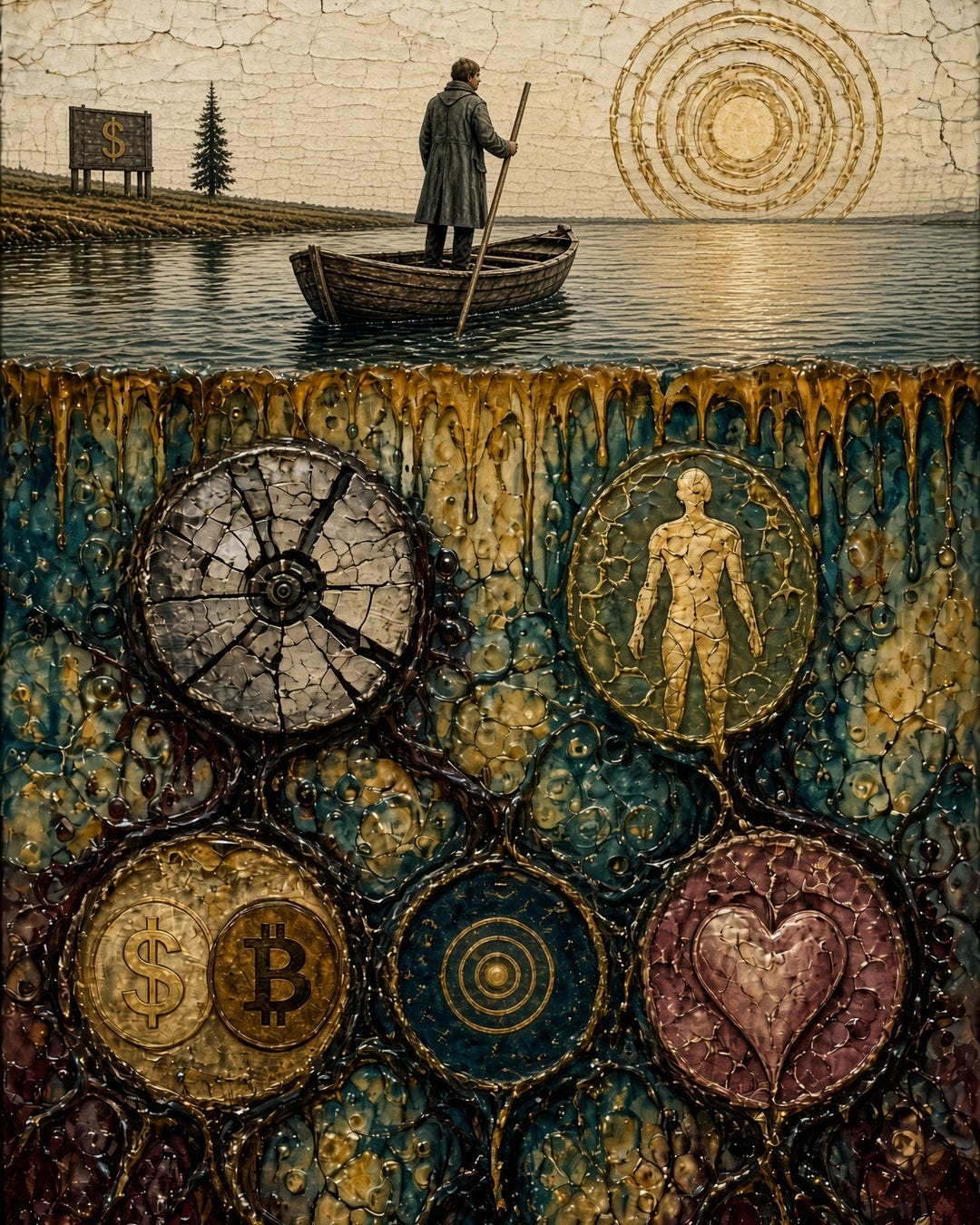
The Human Value Exchange scoreboard measures five forms of wealth:
Time Wealth
Physical Wealth
Financial Wealth
Mental Wealth
Social Wealth
The order reflects how we believe many people will progress, although a human life will never unfold in five clean stages.
We work on all five throughout our lives. A change in one can affect the others, sometimes in ways we do not immediately recognize.
The point is not to reduce a person to five numbers. The scoreboard helps us notice parts of life that conventional measures often leave out.
Time Wealth
Time Wealth begins with an honest look at where our days are going.
Most people we hope to serve are responsible and ambitious. They may have a good income, a home or a plan to buy one, children or children on the way.
On Tuesday morning, they go to what I sometimes call the mortgage job.
The job pays the bills and supports the family. There is dignity in that. Yet part of them may be looking for a way to turn a personal interest or sense of purpose into the work they do.
They intend to explore it when life settles down.
Life rarely settles down on its own.
The workday expands. Messages arrive. Meetings fill the calendar. By evening, little attention remains for training, learning, family or the idea they keep saying they will pursue someday.
Time Wealth asks us to look at our week without judgment.
Where did the time go?
Which activities mattered?
Which ones happened because we consciously chose them?
Which ones continued because we never stopped to question them?
People often think they need to add a new habit. Usually, something else has to stop first.
That applies to founders and small businesses as well.
A business can lose enormous amounts of time to unnecessary meetings, repeated manual work, scattered information and constant reaction. Everyone stays busy while the work that could move the business forward receives whatever energy remains.
Individuals and businesses face the same first question:
Are we spending our time where we intend to spend it?
Physical Wealth
Reclaiming time helps, but a free hour is of limited use when the body has no energy left.
Physical Wealth comes second because change requires energy.
The more fit we become, the more we can do. We recover more effectively, become more resilient and improve our ability to follow through on the commitments we make.
Physical health also affects the other wealths.
Energy helps us work and earn. Fitness supports clearer thinking. Feeling strong and looking better can improve confidence and change how we show up around other people. Experts now show that physical exercise is THE best stress and anxiety thereby adding to Mental Wealth and it’s something you can do with others for greater Social Wealth too.
My own physical transformation taught me that change could become visible.
Losing fifty pounds and later joining the 1,000-pound club gave me evidence that consistent action worked. The changes reached beyond my body. They changed what I believed I could do.
Time creates the opportunity.
Physical Wealth gives us the capacity to use it.
Financial Wealth
Financial Wealth comes next because money can give some of that time back.
Brian often describes its purpose through three words: Time, Choice and Freedom.
Money allows us to make different decisions about how we work, where we live, what we learn and how we support the people around us.
It can help someone move away from work that no longer fits. It can finance a business, pay for education or provide the margin to spend more time with family.
The size of an account tells only part of the story.
Someone can earn a high income while carrying enough debt and obligations to have very little practical freedom. A smaller income combined with more control, lower dependence and clearer priorities may create more choice.
The HVE scoreboard asks what a person’s money is doing.
Is it creating options?
Is it reducing dependence?
Is it returning control over time?
Financial Wealth has enormous power in the physical world. It can fund businesses, create opportunities and help families or communities.
That power also makes money easy to overvalue.
The old scoreboard treats money as the final score.
We treat it as an amplifier. Money expands the choices and intentions of the person who controls it.
Mental Wealth
Mental Wealth may be the most important part of the framework, but we place it fourth.
Changing how we think involves a great deal of unlearning.
Family, school, work, popular culture and social media condition us from an early age. We learn what success is supposed to look like before we have enough experience to decide whether that definition fits us.
New ideas struggle to take root when a person has no time, poor health and constant financial pressure.
The first three wealths help prepare the ground.
Time gives us room to read, reflect, meditate or take a class.
Physical health supports energy and clearer thinking.
Financial capacity can provide access to books, teachers, coaches and experiences that introduce us to different ways of seeing the world.
Mental Wealth grows through knowledge, but information alone is rarely enough.
Many of us already know more than we practise.
Teachers and coaches have mattered so much in my life because they helped me see what I could not see on my own. They also held me accountable for applying what I had learned.
Time, health and financial capacity prepare and water the garden. Then new seeds of thought have a chance to grow.
Social Wealth
Social Wealth comes fifth because the first four wealths increase our ability to understand and help others.
We hear the same instruction every time we fly: put on your own oxygen mask before assisting someone else.
The instruction is practical. We are more useful to others when we can breathe.
The same principle applies to our lives.
If we have greater control over our time, more physical energy, more financial choice and a clearer understanding of ourselves, we have more to bring into our relationships.
We can be more present with a partner.
We may have more patience with our children.
We can contribute to a business, family or community without every act of service leaving us depleted.
Social Wealth is not something we postpone until we have mastered the first four. Our relationships affect us from the beginning, and much of our growth happens through them.
Placing Social Wealth fifth describes where the journey leads.
Self-mastery eventually asks us to look beyond ourselves.
Once we have created more freedom, what will we do with it?
When the old scoreboard stops working
Most people will never say, “My scoreboard is incomplete.”
They will say:
“I don’t have any time.”
“I’m too busy.”
They may be overweight, tired or unable to follow through on the changes they want to make.
They may have a good income but so much debt that they still worry about every major expense.
They may feel that technology, especially artificial intelligence, is moving faster than they can keep up. They worry that it could take their job while other people seem to understand how to use it.
At home, their relationship may have lost the spark it once had. They may love their children deeply while feeling that they no longer understand them.
These experiences can look like separate problems. Often, they affect one another.
A lack of time makes it harder to care for the body. Low energy reduces our ability to learn or create. Financial pressure fills the mind. Mental stress follows us into our closest relationships.
A scoreboard that measures only income and achievement will miss most of this.
The New Scoreboard asks a broader question:
How free are you becoming?
Are you gaining more control over your time?
Does your body give you the energy to pursue what matters?
Does your money create meaningful choices?
Can you direct your attention and question beliefs you inherited?
Are you becoming more capable of understanding and helping others?
Those questions cannot capture the full complexity of a life. They can show us where our attention may be needed.
Where to begin
Before trying to improve five areas at once, think about when you are happiest.
When do you feel most alive?
What are you doing?
Who are you with?
How are you spending your time in that moment?
Then compare those answers with the way you spend an ordinary week.
There may be a gap between what brings your life meaning and what receives most of your time.
That gap is a place to begin.
This does not mean avoiding responsibility or chasing pleasure. Some of the most meaningful parts of life involve sacrifice, discipline and difficult work.
The question is whether those efforts belong to a life you consciously chose.
Learning to steer the ship
Imagine using this scoreboard for a year.
The bills would still arrive. Work would make demands, and family life would remain complicated.
You would have a way to see which part of life needed your attention and how it affected the rest.
Perhaps, for the first time in a long while, you would feel that you could steer the ship again.
You might stop feeling lost at sea or as though you were always swimming against the current.
The scoreboard would become a map.
The greatest treasure is the life you build by following it.
My personal mission is to Teach of the Light.
By that, I mean helping people move toward self-mastery so they can govern their own lives, help their families thrive and support others in doing the same.
I believe that as more people learn to understand and govern themselves, individual flourishing can grow into family flourishing. Stronger families can help create stronger communities and, eventually, a more peaceful world.
Spiritual traditions have described such a future as a thousand years of peace.
That vision may sound distant.
The work begins much closer to home.
It begins with how we spend today.
Over the coming weeks, we will explore Time, Physical, Financial, Mental and Social Wealth in greater depth. We will share what we have learned through our own lives and our work with others.
We also want to learn from you.
Human Value Exchange should live up to its name. The exchange is part of the work.
What does your current scoreboard measure?
What has it taught you to overlook?
Where do you need to begin?
To your freedom,
Hans Westphal, Brian Bogaert and Alan Warner
Human Value Exchange